Thursday, 27 November 2014

The future of Craft education.

At the moment, I am working on my dissertation which will explore how ceramic education can be secured for future generations. I'm looking at the current state of ceramic education and exploring some of the possible reasons why ceramics courses are becoming seemingly less popular and certainly less available. 

Recently, the future of ceramic education has been thrown into doubt. The last decade has seen the majority of higher education ceramic courses closed or adapted into more general 3D or craft programmes. Not only this, with major changes to undergraduate fees in 2012-13, students are now faced with paying £9000 per annum. With all of these changes affecting prospective students, it is not surprising that ceramics is increasingly becoming a niche higher education market. 

My last blog post was written about the ceramic poppies at the Tower of London and how they have captured the public's attention and imagination. People were discussing ceramics in a positive way and I felt like finally, ceramics was getting the public recognition it deserved. However, on November 5th 2014, Falmouth University announced the closure of its Contemporary Craft degree. Ceramics was back in the news, but for negative reasons. Perhaps it's just me who thinks this is slightly ironic... 


This decision has caused dismay for students (shown protesting above) and the creative community, not just on a local level, but nationally too. 
The announcement has also come at a time when the Crafts Council have released information regarding their plans for the future of craft education in a recent publication, “An Education Manifesto for Craft and Making."


These visions and plans fill me with optimism for the future of my practice, yet the closure of another course with a ceramic element brings me back down to earth with a somewhat cynical bang. 

Thankfully, yesterday some of my optimism was restored when I visited a local school which took part in the Craft Council's "Firing Up" scheme. The project aimed to "re-fire" dormant kilns in the UK's secondary schools by teaming them with local Universities. UCLan, where I study was involved and this project is something which a lot of my dissertation research has been about. Yesterday, I met with the Head of Art who specialised in ceramics when he was at University. I interviewed him about the "Firing Up" scheme and his general thoughts about the future of ceramic education. 


The ceramic work from the school was generally fantastic. Seeing the classrooms lined with clay creations (such as the one shown above) was so encouraging. But there was one particular thing I was drawn to - a collection of work from a student who is visually impaired. This particular student was desperate to do art - being able to use clay has made this possible for him. He is the first pupil at the school to study for a ceramics GCSE. Some of his beautiful, tactile pieces are shown below.


I have aspirations to teach and currently, the future of the career I aspire to is in doubt. It was so inspirational and amazing to have my passion and love for a subject reaffirmed by another student. This, for me, truly confirms that is it fundamental for ceramics and crafts subjects to remain part of any education. 

To support Falmouth University's Contemporary Craft course, please take the time to sign this petition opposing the closure:
https://you.38degrees.org.uk/petitions/oppose-falmouth-university-closing-the-contemporary-crafts-degree


To read more about the Craft Council's Education manifesto, check out this link:
http://www.craftscouncil.org.uk/what-we-do/education-manifesto/

Finally, if you're interested in learning more about the success of the Craft Council's "Firing Up" scheme, this video is a must-see:


Saturday, 18 October 2014

"Blood Swept Lands and Seas of Red"

This major and current art installation, Blood Swept Lands and Seas of Red at the Tower of London, marks one hundred years since Britain's first full day of involvement in the First World War. 888,246 ceramic poppies - each representing a British military fatality during the war - will progressively fill the Tower's famous moat. 


The first of these flowers were planted on August 5th 2014, one hundred years since the first full day of fighting in the war. The last one will be planted on November 11th - Remembrance Day.

The iconic red poppy is a symbol of remembrance because in Western Europe, it is the first wildflower to appear when soil is disturbed. So after the war, the fields where soldiers fell became large regions of crimson blooms. For me, this idea somewhat reflects the installation – something beautiful and symbolic arising from tragedy. The name of this installation is also symbolic - originating from a poem written by an anonymous soldier in World War I: "The Blood Swept Lands and Seas of Red."

The ceramic poppies were designed by artist Paul Cummins, who worked in collaboration with stage designer Tom Piper who was involved with the installation process. Cummins has become well known for his energetic ceramic flowers and vibrant glazes, combined with the raw presence of steel and wire. Piper is a British theatre designer. Each poppy was handmade by a team of volunteers in Derby and Stoke, working around Paul Cummins’ concept.


This video shows the making process of the ceramic poppies. Like many hand-building projects, the clay was cut and rolled into large flat sheets using a traditional ceramic rolling mill. A metal stamp (like a large cookie cutter) was used to cut petals from the sheets of clay, which were then paired together to form six overlapping petals.


The petals were then individually moulded by every artist to create the shape of the flower. I love this part of the making process because even though the makers were required to use one uniform cutting technique, the moulding by hand allows each poppy to be completely unique – not only in its appearance but also through its maker. I feel that this intimacy and interaction gives each poppy a background – a story within a story, making up this vast commemorative piece.


The poppies were then finished with a weatherproof, red glaze and assembled with metal and rubber components, ready to be ‘planted’ on site. Although the glaze is resilient, the intention is that each poppy and its metal stem will rust, weather and begin to look more natural after three months braving the British outdoors – adding yet another level to each piece’s individuality and narrative.


I really like that this piece is always evolving. It is currently in the process of a gradual installation at the Tower of London and once the poppies are removed from the site, they will be sent to new homes nationwide. The poppies have been available to individually purchase for £25, which will raise millions for six charities, one example being Help for Heroes. This idea means that each poppy will continue to be a symbol of remembrance all over the country for years to come. The longevity of ceramics is hugely significant and will allow these poppies to be treasured items for decades.


As a ceramicist, history lover and a bit of a World War obsessive, this piece is a dream come true. It successfully and intelligently commemorates a vital part of Britain’s history and I admire that a traditional craft like ceramics was the chosen material. Crafts such as ceramics are often misunderstood disciplines, so to use clay on such a large scale is really inspiring. Ceramics in the press and public eye can only be a positive thing for designer makers in this field.

As well as celebrating a practice I am passionate about, this huge project holds some personal significance because my Great, Great Grandfather was one of the 888,246 military fatalities during World War I. On Monday 18th August 2014 the name of James Gregory, Loyal North Lancashire Regiment was among the list of one hundred and eighty names read from the Tower moat at sunset (you can see this two minutes into the video below). This personal connection to the piece is something I am sure to share with many others nationwide, adding yet more significance to an already symbolic piece of art. 

Creativity takes courage.

Winston Churchill 


Monday, 29 September 2014

Inspirational Figure

Clare Hillerby is a contemporary jeweller who combines ephemera and metal work to create stories within her ambiguous pieces.

Hillerby graduated from Edinburgh College of Art in 1997 with a BA (Hons) in Jewellery and Metalwork, and afterwards received a Start-Up Grant from the Scottish Arts Council to set up her studio and business in Edinburgh. She has travelled nationwide, across Europe and the USA for exhibitions and fairs, but is now mainly based in Manchester Craft and Design Centre, where she designs and makes her one-off jewellery pieces.

The metal aspects of her work are inspired by textures found in the city’s urban environment and make reference to Britain’s industrial heritage. Although British history is something I am really interested in, the narrative in Hillerby’s work is what I am immediately drawn to and excited about.

As well as jewellery, Hillerby creates beautiful, layered paper collages from her collected ephemera. These nostalgic pieces immediately set my imagination racing. They have a tactile quality and each layer reveals more of the unknown, intriguing story. I can see these paper collages being transformed into surfaces for ceramic pieces.

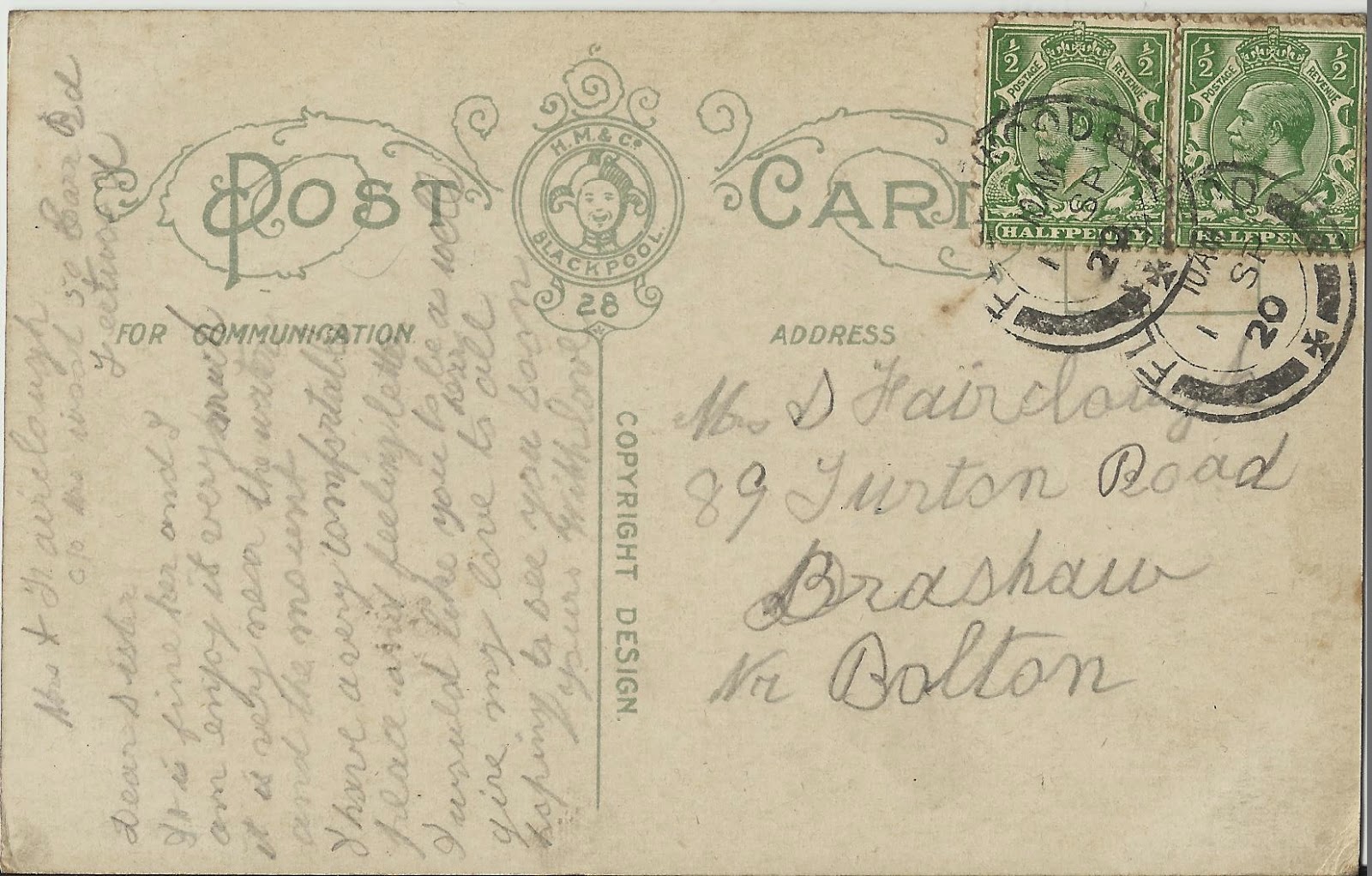
The main starting point for Hillerby’s work is handwriting – like me, she is captivated by the ambiguity of old, handwritten documents. Similarly to me, Hillerby collects old postcards (the one below is part of my huge collection) stamps, maps and photographs, then transforms them to create new, contemporary stories.


In a way, I become sentimental about the object’s original story being changed by Hillerby, but admire her ability to restore it and give it a new, beautifully communicated meaning. 


When I find discarded, unwanted photographs (like the one above which I found in a local antique shop) I feel obliged to cherish them – my imagination runs wild and I invent stories about the ‘characters’ in the image before me. This is something I think Hillerby does, too. Each of her pieces is based on an unknown character - the fictional, whimsical element of her work is what inspires me.

Some of my work is informed by ephemera I know a lot more about, such as my Grandma's postcards, photographs, recipe books and old letters. These things (shown in the image below) that my Grandma hoards are often the starting point for most of my pieces. 


Looking at the starting point for Hillbery's work, it is clear to see that we are inspired by similar things. I find it interesting to see how a designer who works in a different discipline applies this nostalgia to her work. 

I have come across Hillerby’s work several times, mainly at Manchester Art Gallery and Manchester Craft and Design Centre - local places I often visit when I need some inspiration. Although I am not a jeweller and don’t often look into that aspect of craft, Clare Hillerby’s pieces have inspired me for several years. The way she transforms unwanted, unloved objects into something precious is something that inspires my practice as an aspiring designer maker. 


Keep up with Clare Hillerby's work:
http://clarehillerby.wordpress.com/

http://www.clarehillerby.co.uk/
https://www.facebook.com/clarehillerbyjewellery?fref=ts